
Commercial Disinfection Services in Toronto
Pro-Clean provides commercial disinfection services for offices, managed properties, retail spaces, industrial facilities, and other businesses across Toronto and the GTA. Since 1995, our team has delivered professional janitorial services and facility-specific cleaning programs for commercial clients.
Disinfection is most effective when it follows proper cleaning. Visible soil and residue are removed first, then an appropriate disinfectant and application method are selected for the surface, setting, and service objective. Depending on the approved product label and facility requirements, service may involve manual wiping, electrostatic spraying, misting, or fogging.
Programs can be arranged as a one-time response, targeted high-touch service, or an added component of recurring commercial cleaning. The scope, product information, access requirements, contact time, ventilation, and re-entry instructions should be confirmed before work begins.
Commercial Facilities We Can Support
Disinfection can be added to a routine cleaning program or arranged as a targeted service for high-touch surfaces and shared areas. The exact scope depends on the property, surface materials, operating requirements, and the product selected for the facility.
- Offices and office buildings
- Banks and financial institutions
- Retail stores and customer-facing spaces
- Condo and managed-property common areas
- Warehouses and factories
- Automotive dealerships
- Commercial buildings and plazas
- Grocery and supermarket environments
- Medical and dental environmental surfaces
- Schools, childcare, and institutional spaces when within the agreed scope
Pro-Clean serves businesses across Toronto, the Greater Toronto Area, and Southern Ontario. Visit our service areas page or contact us to confirm coverage for your property.
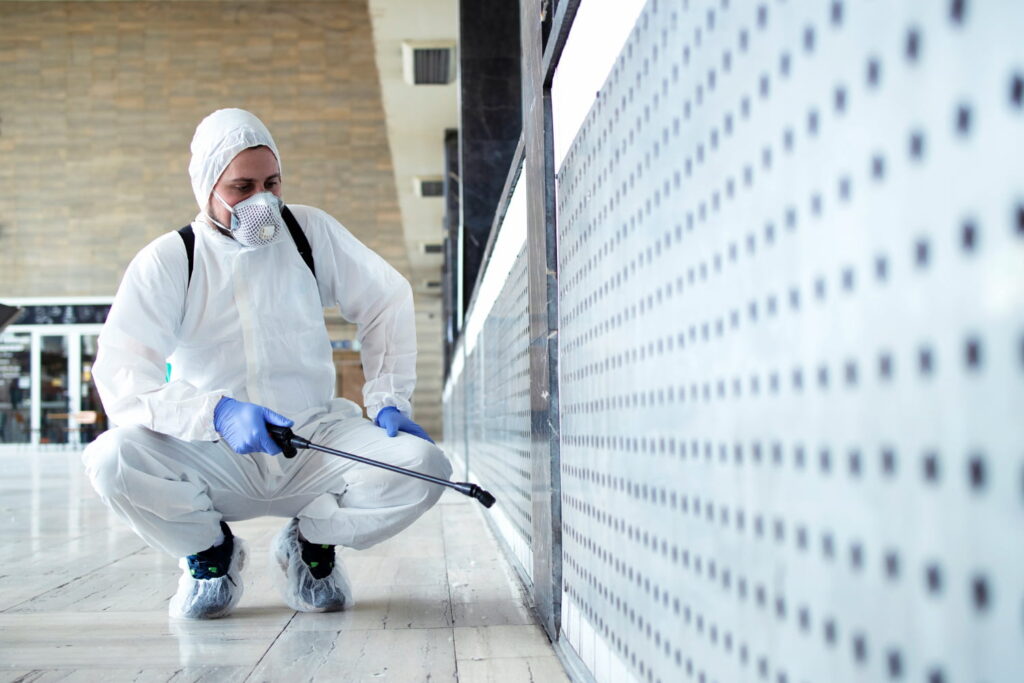
Commercial Disinfection Methods Explained
The best method is not automatically the most aggressive one. It is the method supported by the product label, compatible with the surfaces, and practical for the facility.
Manual Wiping
Useful for high-touch hard surfaces because the technician can control coverage, avoid sensitive equipment, and maintain the required contact time.
Electrostatic Spraying
Charged droplets can improve coverage around compatible objects and surfaces. It should be used only when the disinfectant label permits electrostatic application.
Fogging or Misting
May support broad-area treatment in suitable spaces, but only when the selected product is authorized for that application method and ventilation and re-entry can be managed.
Targeted High-Touch Service
Focuses on frequently handled surfaces such as door hardware, elevator controls, counters, railings, shared equipment, and washroom touchpoints.
When to Consider Enhanced Disinfection
Enhanced disinfection may be appropriate after a reported contamination event, during periods of increased illness concern, before reopening an affected area, or as part of a planned high-touch maintenance program. It does not replace routine cleaning, hand hygiene, ventilation, or the facility’s own infection-control policies.
- After a confirmed or suspected contamination event, subject to the facility’s protocol
- Before reopening a temporarily closed or affected space
- For high-traffic shared areas with frequent surface contact
- As a planned supplement to recurring janitorial or office cleaning
What Affects the Cost of Commercial Disinfection?
A site-specific quote is based on the actual work required rather than a generic fogging price.
Commercial Disinfection FAQs
Clear answers about cleaning, disinfecting, product selection, application methods, access, and pricing.
What is the difference between cleaning, sanitizing, and disinfecting?
Cleaning removes dirt, residue, and organic material from a surface. Sanitizing reduces microorganisms to a level defined by the product claim. Disinfecting uses an authorized product to kill or inactivate specified microorganisms on compatible inanimate surfaces when the label directions are followed.
Do surfaces need to be cleaned before they are disinfected?
Usually, yes. Visible dirt and residue can interfere with disinfectant performance. The service plan identifies where pre-cleaning is required before the disinfectant is applied.
Is fogging always the best disinfection method?
No. Fogging is one possible application method. Manual wiping or electrostatic spraying may be more appropriate for some spaces and surfaces. Fogging should be used only when the selected product label permits it and the facility can meet ventilation, access, and re-entry requirements.
How do you choose the disinfectant and application method?
The choice depends on the facility type, target surfaces, product authorization, label claims, surface compatibility, contact time, occupancy, ventilation, equipment sensitivity, and the reason for service. The proposed product and method should be confirmed before work begins.
Can we review the product information before service?
Yes. Ask for the product label, safety data sheet, Drug Identification Number or current Canadian authorization where applicable, required contact time, PPE guidance, and re-entry instructions.
How long must the space remain vacant after treatment?
There is no universal time. It depends on the product label, application method, ventilation, surface drying, and facility conditions. Re-entry instructions are confirmed as part of the service plan.
Can Pro-Clean disinfect medical and dental facilities?
Pro-Clean can provide cleaning and disinfection for agreed environmental surfaces and common areas. This does not replace sterilization or high-level disinfection of clinical instruments, nor does it replace a clinic’s infection-prevention and control procedures.
How much do commercial disinfection services cost in Toronto?
Pricing depends on facility size, surface types, the amount of cleaning required first, product and application method, access, ventilation, urgency, and service frequency. A walkthrough or detailed scope is the best way to prepare an accurate quote.